


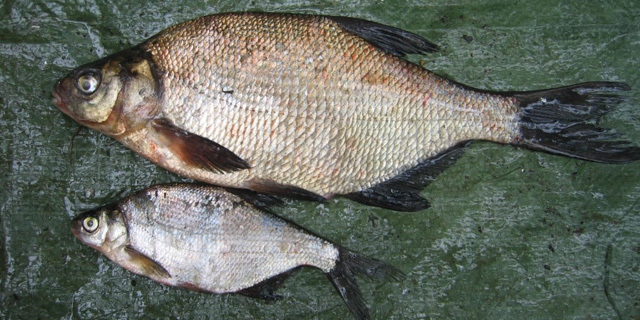
Bream (Abramis brama) is a species in the carp family. It prefers still water and prefers fresh water, but the fish also occurs in brackish water. Bream is Södermanland's landscape fish.
Appearance
Prevalence
Europe's southern border runs along the Alps and southern France. In the east it is found up to the Aral Sea. In Scandinavia, it is generally found in Denmark, south-eastern Norway, up to central Sweden and along the entire Norrland coast, as well as in southern and central Finland. It also flows into the brackish waters of the northern and eastern Baltic Sea.
Habits
The bream is a shoal and bottom fish that lives in lakes and slow-flowing streams. Young fish are mainly plankton eaters, while older ones mainly live on insect larvae and other benthic animals, which they suck up from the bottom with their extendable mouths.
Reproduction
Bream spawn in spring and early summer in shallow water. The female can lay up to a total of 300,000 eggs on several occasions. The eggs, which are barely 2 millimeters in size, hatch after 1 to 2 weeks. The fish become sexually mature at 3–6 years of age. However, fish from juvenile populations can be considerably older.
Fishing in Sweden
Bream are popular for angling. It is not common as a food fish in Sweden, but is sold smoked in Russia. The bream consists of many bones. The Swedish sport fishing record is 7.04 kg. The largest bream caught in Sweden in commercial gear weighed 9.2 kilos and was 82 cm long; it was caught in Ringsjön in Scania. During the summer, you can conduct successful bream fishing with a light tackle baited with worm or corn, or both, so-called "cocktail". Also "casters" (pupated maggots) are supposed to be a good bait.