


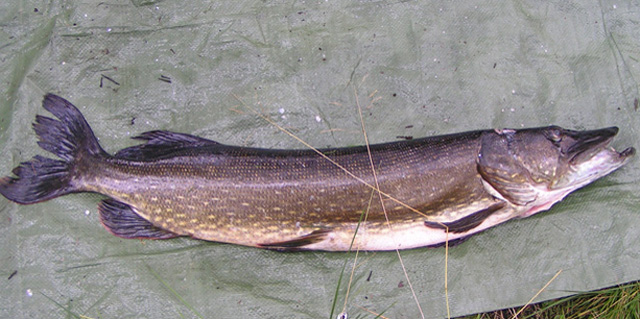
The pike has an elongated, coil-shaped body. The head is large and the nose is flattened from above. The gap is very large. The pelvic fins are located far behind the pectoral fins, and the small dorsal fin is located far back, just in front of the tail root and above the anal fin. The back is grey-green, often dark. The sides are slightly lighter and to varying degrees yellow-striped, the belly pale yellow. The fins are greenish. The females become significantly larger than the males.
Normally pike are territorial claimants, but there are also permanently migratory pike that follow shoals of streams. These pike – which always swim at depth and have no use for a camouflage color reminiscent of reeds – are more golden yellow and are called "streaming pike", in contrast to the young pike that in relatively shallow water only live among the reeds; they are called "grass pike" after their green striped body.
The pike spawn in early spring in shallow bays, preferably flooded fields and fields, where the sun warms the water early. The pike fry live on insect larvae and the like, from around 10 centimeters in length they usually switch completely to a fish diet. Growth is very fast.
An adult pike has few natural enemies. Osprey like to take pike, and can sometimes hit pikes that are so big that the bird cannot lift and has to drop its prey. Although doubtful in their veracity, there are also reports of large pike pulling the gosling below the surface, and drowning the bird of prey. Small pike are primarily threatened by larger pike and other predatory fish, such as perch and zander.
In the old days people "shot" pike. When the pike was spawning in shallow water, a shot was fired under the fish, which was then stunned. The method is today banned.
The pike is a predatory fish and thus eats other fish, even conspecifics. The pike always swallows fish prey head first, and can easily handle prey up to half its own length. The pike is also designed so that it cannot spit out prey once it has started to swallow it, as the large teeth are directed backwards. Thus, a prey can hardly escape if the pike has hit it. Sometimes, however, this can be to the pike's disadvantage, as it risks suffocation if it has caught too large a prey.
The pike eats anything alive it can catch, including waders and small waterfowl (especially young birds), but the main food is smaller fish.
An indication of the pike's appetite can be the effect its presence has on the prey fish – for example, rudd living in pike-rich waters develop a distinct dorsal hump, thus becoming more difficult prey for the pike. Large pike in smaller waters should be protected, as the diversity of fishable species can be maintained. The predation the large pike practice is important so that relatively smaller pike do not become too numerous. Therefore, pikes over 3 kg should generally be returned because they are not good food fish anyway and inhibit pike production so that the pike do not gain the upper hand.
Prevalence
Freshwater and brackish water,
- naturally in the south to the Pyrenees, central Italy and the Balkans. In the east all of Russia and further through northern and central Asia to the Bering Strait and Kamchatka. It also occurs in Ireland and the British Isles, except in northern Scotland. In North America Alaska, Canada and the eastern United States.
- implanted in Spain and found in Portugal.
- Occurrence in Sweden: common throughout the country, except at the top of the mountain range where it only occurs sporadically.
Life span
33 years in Finland. 30 years have been established in England and 16 years in Sweden.
Size and record
Pikes have a very rapid growth in the first years and grow like all fish throughout their lives. The female becomes larger than the male. In Sweden (Stockholm's archipelago), kingfish can be as long as 143 cm and weigh up to 26.5 kg.
Swedish record - females
A large pike from the lower Dalälven There are a lot of more or less incredible reports that are totally lacking in verification, usually because they must have been caught a long time ago. This includes, for example, the pike that must have weighed 31.5 kg from Ljusterö and another specimen from Hornavan in 1976 of 30 kg. Then there are plenty of reports of pike between 29-33 kg, most of them impossible to prove.
- 26.57 kg, Järnafjärden, 1986. There is some doubt: was disqualified as a sport fishing record due to doubts about the method of capture.
- 24.17 kg, Norra Mörkö, 1984. Caught by the same angler as the 26.57 kg pike above, but this too was disqualified as a sport fishing record because the specimen was weighed on an unapproved bathroom scale.
- 23.5 kg, Grindbysjön, Orust, 1988. Caught in "ryssja".
- 23.0 kg, Omnefjärden, Nordingrå 1957. Caught in a net.
- 22.5 kg, Baltic Sea, Örnsköldsvik, 1954. Caught in nets. Prepared.
- 22.5 kg, Mälaren, 1973. Due to poor evidence, the record was declared invalid. The record was declared vacant.
- 19.34 kg, Vättern, 1999. Applicable Swedish sport fishing record for pike. See also http://www.sportfiskarna.se/storfiskregistreringen/sotvattenrekord.asp
A number of fish over 20 kg were caught in the Lödde å in Skåne during the 80s and 90s, but these were deleted when the record was declared vacant. In general, the vast majority of reports about so-called large pike should be treated with great skepticism.
Swedish record - males
- Hammarsjön, Strömsnäsbruk, Småland: 11.8 kg, 122 cm.
- Kävlingeån, Skåne: 10,15 kg, 103 cm.
Miscellaneous
The pike is a fine food fish. Among the most popular ways of cooking the fish can be mentioned pate. It can also be cooked and eaten with horseradish, so-called horseradish pike. Or fried, breaded in an oven in plenty of butter that is pressed on the back, so-called oven pike. In Europe outside the Nordic countries, the pike is considered a very exclusive food fish.
The word "pike" simply means "barb" referring to its teeth. It has the same meaning in English (pike - pik) and French (brochet, formed from broche - brosch, needle). The Swedish Pike Association protects this fish. In a Russian fairy tale, a man catches a talking pike.